
- Home
- »
- Advanced Interior Materials
- »
-
Gold Nanoparticles Market Size, Growth Report, 2026-2033GVR Report cover

Gold Nanoparticles Market (2026 - 2033)
Size, Share & Trends Analysis Report By End-use (Medical & Dentistry, Electronics, Catalysis, Others) By Region (North America, Europe, Asia Pacific), And Segment Forecasts
Market Size, 2025
$9.4BMarket Estimate, 2026
$10.4BMarket Forecast, 2033
$21.2BCAGR, 2026–2033
10.7%Gold Nanoparticles Market Summary
The global gold nanoparticles market was valued at USD 9.4 billion in 2025 and is projected to grow from USD 10.4 billion in 2026 to USD 21.2 billion in 2033, at a CAGR of 10.7% from 2026 to 2033. The Asia Pacific dominated the market, accounting for a revenue share of 37.0% in 2025. The increasing use of metal nanoparticles in medicine and dentistry, particularly in target imaging and diagnostics, is driving market growth.
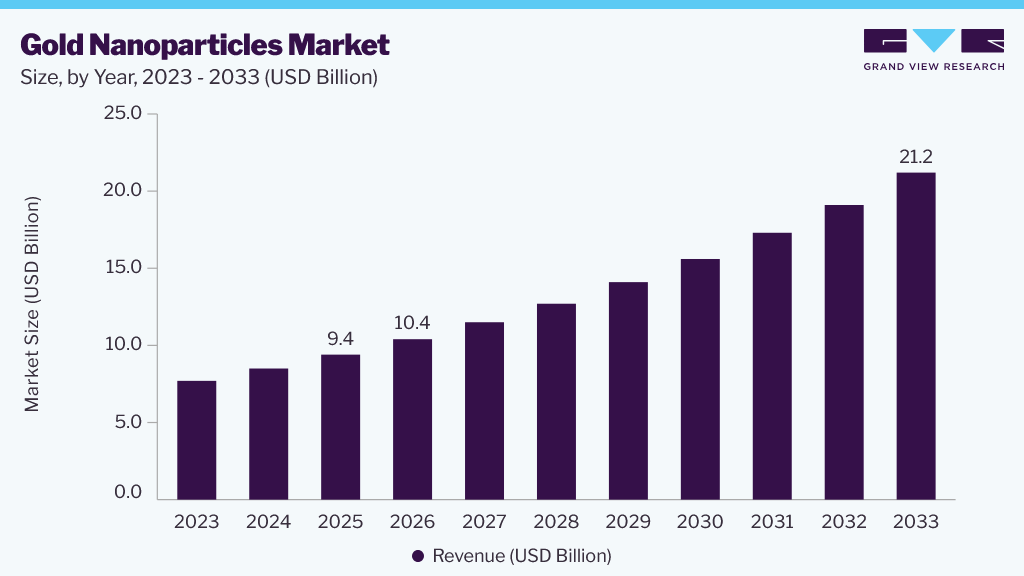 Source: Grand View Research, IR Documents, Primary Interviews, Paid DatabasesTo learn more about this report,
 Download Free Sample Report
Key Market Trends & Insights
- By end use: The medical & dentistry segment dominated the market and accounted for a share of approximately 51.0% in 2025.
- By end use: The electronics segment is expected to register the fastest CAGR during the forecast period.
Regional Highlights
- Largest regional market: Asia Pacific (37.0% revenue share, 2025)
- Fastest-growing regional market: Asia Pacific (Highest CAGR, 2026-2033)
Market Size & Forecast
- Market size in 2025: USD 9.4 Billion
- Estimated market size in 2026: USD 10.4 Billion
- Projected market size by 2033: USD 21.2 Billion
- CAGR (2026-2033): 10.7%
Three ways to get this report
Buy it, customize it, or ask a question.Ask an Analyst
Analyst response in 1 business day
- AccessReport author, directly
- Reply timeWithin 1 working day
- No sales callDirect answer only
- FormatEmail reply
- CostFree, no cost
Get the Full Report
What the study covers
- FormatsPDF · Excel · Dashboard
- Timeline2026–2033 annual, 2025 base
- Coverage20+ countries, 5 regions
- Companies10+ key players profiled
Customize the Report
20% free customization
- IncludeCountries, segments, points
- TailorTo your product definition
- ExtendDeeper competitor detail
- OrA fully bespoke study
- Turnaround5–10 working days
The gold nanoparticles market is expected to witness significant growth over the forecast period, driven by the expanding application of gold nanoparticles in medical imaging, diagnostics, and targeted therapeutics. Their superior optical, electronic, and biocompatible properties make them highly suitable for various biomedical applications. Gold nanoparticles exhibit high absorption, strong scattering, and excellent optoacoustic properties while offering minimal interference from bone and tissue, enhancing imaging accuracy and diagnostic efficiency. Their ability to selectively accumulate in tumor cells further supports their growing adoption in targeted cancer imaging and therapy.
Extensive research and development in gold nanotechnology has significantly broadened its applications across pharmaceuticals, electronics, glass technology, photometry, and biosensors. In the pharmaceutical sector, gold nanoparticles are increasingly used to improve the pharmacokinetic and pharmacodynamic performance of drug molecules, supporting enhanced targeted delivery and therapeutic efficacy. For instance, in March 2024, researchers from Goa University reported advances in mushroom-mediated biosynthesis of gold nanoparticles for potential applications in cancer treatment. The study highlighted the ability of certain mushroom species to synthesize biocompatible gold nanoparticles with promising therapeutic potential in oncology. In addition, rising demand from the electronics industry and increasing use of gold nanowires in biosensors and advanced sensing applications are further supporting market growth.
However, stringent regulations imposed by regional and national authorities regarding the use of nanomaterials in commercial products may restrain market growth. Concerns related to toxicity, environmental impact, and long-term safety continue to present challenges for large-scale commercialization and broader adoption of gold nanoparticles across industries.
Analyst Perspective
The gold nanoparticles market is expected to grow steadily, driven by the increasing adoption of nanotechnology across healthcare, electronics, pharmaceuticals, diagnostics, and advanced industrial applications. Rising demand for gold nanoparticles in targeted drug delivery, cancer diagnostics, photothermal therapy, bioimaging, and biosensing is significantly supporting market expansion, particularly as healthcare systems increasingly adopt precision medicine and minimally invasive treatment approaches. Beyond healthcare, the growing use of gold nanoparticles in sensors, conductive inks, electronics, and advanced functional materials is expanding their commercial potential across multiple industries. Their unique optical, electrical, and surface properties continue to support innovation in high-performance and miniaturized applications. Furthermore, increasing investments in nanomedicine research, advancements in synthesis technologies, and rising focus on functionalized nanoparticles are improving scalability, performance, and commercial viability. The development of green synthesis methods and surface-engineered nanoparticles is also creating new opportunities by enhancing application-specific performance across biomedical, industrial, and research applications.
End Use Insights
The medical & dentistry segment dominated the market, accounting for approximately 51% in 2025, driven by the expanding application of gold nanoparticles in medical imaging, therapeutics, and diagnostics. Increasing investments in R&D for advanced drug delivery systems and cancer-targeted nanoparticle technologies are further supporting segment growth. According to the National Nanotechnology Initiative, gold nanoparticles are under clinical investigation for the treatment of cancer and other diseases due to their unique optical and surface properties. The growing adoption of nanotechnology-based therapeutics, diagnostics, and imaging solutions in the healthcare sector is accelerating demand for gold nanoparticles. In addition, ongoing advances in nanomedicine and growing awareness of the benefits of metal nanoparticles are expected to further drive segment growth over the forecast period.
The electronics segment is expected to register the fastest CAGR during the forecast period, driven by the increasing adoption of gold nanoparticles in printed electronics, flexible devices, sensors, and photovoltaic applications. The unique electrical conductivity, stability, and nanoscale properties of gold nanoparticles make them highly suitable for advanced electronic components and miniaturized devices. In addition, rising demand for nanomaterials in biosensors and nanowire-based sensing devices is further supporting segment growth. For instance, in June 2026, researchers at Linköping University developed an electronic gold ink capable of printing highly conductive patterns for use in flexible electronics, sensors, and advanced electronic components, highlighting the growing application of gold nanomaterials in next-generation electronic devices. Gold nanoparticle inks are increasingly used in conductive inks, photovoltaic cells, photo-sensors, detectors, and thin-film transistors, supporting broader adoption across the electronics industry.
Regional Insights
The North America gold nanoparticles market accounted for a significant share of revenue in 2025, driven by the region’s well-established healthcare infrastructure, strong research ecosystem, and increasing adoption of nanotechnology in medical applications. Rising investment in research and development across the pharmaceutical, diagnostics, and nanomedicine sectors is expected to further support market growth over the forecast period. Growing demand for advanced drug delivery systems, antiviral therapeutics, and precision diagnostics is accelerating the adoption of gold nanoparticles across the region. According to a research article published in Assay and Drug Development Technologies in December 2024, gold nanoparticles demonstrated significant antiviral potential by improving drug delivery efficiency, binding directly to viral particles, and inhibiting viral replication through surface functionalization and intracellular interactions. Such advancements are expected to further strengthen the demand for gold nanoparticles in North America.
U.S. Trends
The U.S. gold nanoparticles market dominated the North American market in 2025 due to advancements in nanotechnology and its applications across various sectors, particularly in biomedical fields. The increasing prevalence of cancer and other chronic diseases has spurred research into targeted drug delivery systems, in which gold nanoparticles are used for their unique optical properties and biocompatibility. This trend is supported by substantial investments from both the public and private sectors in nanomedicine, leading to a surge in clinical trials leveraging gold nanoparticles for imaging and therapeutic purposes.
Europe Gold Nanoparticles Market Trends
Europe gold nanoparticles market held a substantial market revenue share in 2025, owing to increased healthcare spending and innovations in in-vitro therapeutics and diagnostics. Moreover, potential demand from Europe, driven by the growing medical and healthcare sector, is expected to contribute to regional growth. Expanding the application scope of nanoparticles for glass tinting, photovoltaic plates, and fruit protection presents an opportunity for market players. Furthermore, growing niche applications, such as nanowires and fruit and vegetable protection, will also create enormous opportunities for the market in the near future.
The UK gold nanoparticles market is anticipated to grow significantly in the coming years due to the strong pharmaceutical sector, which significantly drives demand for gold nanoparticles in drug formulation and delivery systems. With major pharmaceutical companies investing heavily in nanomedicine research, there is an increasing need for effective carriers that enhance bioavailability while minimizing side effects. Gold nanoparticles offer unique advantages, such as controlled release mechanisms and improved solubility, making them highly sought after in drug development.
Asia Pacific Gold Nanoparticles Market Trends
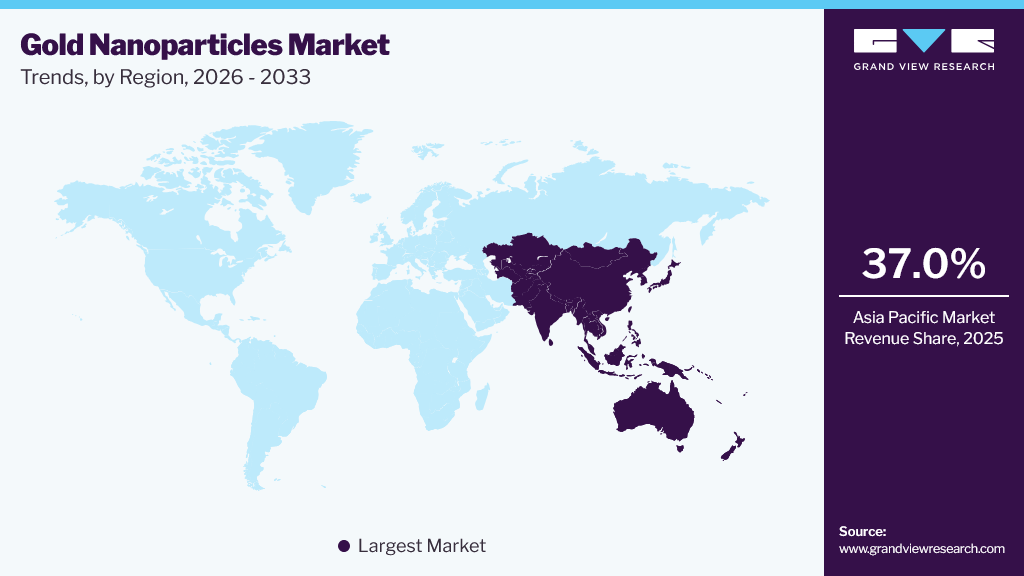
The Asia Pacific gold nanoparticles dominated the market, accounting for a revenue share of 37.0% in 2025 and is anticipated to register the fastest CAGR over the forecast period. This growth is primarily driven by rising healthcare expenditure across emerging economies, expanding healthcare infrastructure, and increasing adoption of advanced nanotechnology-based solutions. The region’s large population base and growing prevalence of lifestyle-related diseases are creating significant opportunities for gold nanoparticle applications in diagnostics and therapeutics. Recent advancements in gold nanoparticle-based molecular sensing are further supporting market growth, particularly in biomedical diagnostics, where aggregation-based optical detection systems enable highly sensitive and selective detection of disease-related biomolecules. In addition, the increasing use of gold nanoparticles in targeted treatment approaches is improving therapeutic precision and treatment efficiency, further driving regional market growth.
 To learn more about this report, Download Free Sample Report
The Japan gold nanoparticles market is expected to grow rapidly in the coming years due to an advanced technological landscape characterized by high levels of investment in research and development across sectors such as electronics, pharmaceuticals, and materials science. Japanese companies are pioneers in integrating nanotechnology into consumer products, thus driving demand for high-quality gold nanoparticles used as conductive materials or catalysts within electronic devices.
Key Gold Nanoparticles Company Insights
Some of the key companies in the gold nanoparticles market include Cytodiagnostics Inc., Goldsol Inc, BBI Solutions, Nanopartz Inc., and others.
- Cytodiagnostics Inc. offers a broad portfolio of gold nanoparticle products, including spherical gold nanoparticles, carboxyl-functionalized nanoparticles, and gold nanorods. These products are available in multiple sizes and surface chemistries for applications such as conjugate development, lateral flow assays, biosensor development, and cellular imaging.
- BBI Solutions provides high-quality colloidal gold nanoparticles with excellent stability, consistent size distribution, and customizable surface properties. These nanoparticles are widely used in immunoassays, lateral flow diagnostics, and biosensor applications, supporting advanced diagnostic and research requirements.
Key Gold Nanoparticles Companies
The following key companies have been profiled for this study on the gold nanoparticles market
-
Cytodiagnostics Inc.
-
BBI Solutions
-
Nanopartz Inc.
-
TANAKA PRECIOUS METAL GROUP Co., Ltd.
-
METALOR Technologies SA
-
Merck KGaA
-
nanoComposix (Fortis Life Sciences company)
-
Johnson Matthey
-
Meliorum Technologies, Inc.
-
Sona Nanotech
-
CD Bioparticles
Recent Developments
-
In May 2025, NovaCentrix advanced the development of precision gold nanoparticle inks for high-resolution, high-aspect-ratio printing in printed electronics. These Metalon gold inks enable fine conductive patterning on flexible substrates with high conductivity and strong adhesion, supporting applications in sensors, biomedical devices, and advanced electronic components.
-
In May 2025, Sona Nanotech entered into a research collaboration with BioVaxys Technology Corp. to evaluate the combined use of its proprietary gold nanorod (GNR) technology and BioVaxys’ DPX immune-educating platform to develop advanced cancer therapeutics. The collaboration focuses on leveraging gold nanoparticle-enabled photothermal hyperthermia to selectively target solid tumors while simultaneously enhancing immune system response through antigen presentation.
Gold Nanoparticles Market Report Scope
Report Attribute
Details
Market size in 2025
USD 9.4 Billion
Estimated market size in 2026
USD 10.4 Billion
Projected market size by 2033
USD 21.2 Billion
Growth Rate
CAGR of 10.7% from 2026 to 2033
Base year for estimation
2025
Historical data
2021 – 2024
Forecast period
2026 – 2033
Quantitative units
Revenue in USD Million, Volume in Kilo Grams, and CAGR from 2026 to 2033
Report coverage
Revenue forecast, company ranking, competitive landscape, growth factors, and trends
Segments covered
End Use, region
Regional Scope
North America; Europe; Asia Pacific; Latin America; MEA
Country Scope
U.S.; Canada; Mexico; Germany; U.K.; France; Italy; Russia; Spain; Australia; South Korea; China; India; Japan; Brazil; Argentina; Saudi Arabia; and South Africa
Key companies profiled
Cytodiagnostics Inc.; BBI Solutions; Nanopartz Inc.; TANAKA PRECIOUS METAL GROUP Co., Ltd.; METALOR Technologies SA; Merck KGaA; nanoComposix (Fortis Life Sciences company); Johnson Matthey; Meliorum Technologies, Inc.; Sona Nanotech; CD Bioparticles
Customization scope
Free report customization (equivalent up to 8 analysts working days) with purchase. Addition or alteration to country, regional & segment scope.
Pricing and purchase options
Avail of customized purchase options to meet your exact research needs. Explore purchase options
Global Gold Nanoparticles Market Report Segmentation
This report forecasts revenue growth at global, regional, and country levels and provides an analysis of the latest industry trends and opportunities in each of the sub-segments from 2021 to 2033. For the purpose of this study, Grand View Research has segmented the global Gold Nanoparticles market report based on end use and region:
-
End Use Outlook (Revenue, USD Billion; Volume, Kilo Grams; 2021 - 2033)
-
Medical & Dentistry
-
Electronics
-
Catalysis
-
Others
-
-
Regional Outlook (Revenue, USD Billion; Volume, Kilo Grams; 2021 - 2033)
-
North America
-
U.S.
-
Canada
-
Mexico
-
-
Europe
-
Germany
-
UK
-
France
-
Italy
-
Spain
-
-
Asia Pacific
-
China
-
Japan
-
India
-
South Korea
-
Australia
-
-
Central & South America
-
Brazil
-
Argentina
-
-
Middle East and Africa (MEA)
-
South Africa
-
Saudi Arabia
-
-
Frequently Asked Questions About This Report
The global gold nanoparticles market size was valued at USD 9.4 billion in 2025 and is estimated at USD 10.4 billion for 2026.
The global gold nanoparticles market is expected to grow at a CAGR of 10.7% from 2026 to 2033, reaching USD 21.2 billion.
The medical & dentistry segment accounted for the largest revenue share of approximately 51.0% in 2025.
Key players in the market Cytodiagnostics Inc.; BBI Solutions; Nanopartz Inc.; TANAKA PRECIOUS METAL GROUP Co., Ltd.; METALOR Technologies SA; Merck KGaA; nanoComposix (Fortis Life Sciences company); Johnson Matthey; Meliorum Technologies, Inc.; Sona Nanotech; CD Bioparticles, and others.
Asia Pacific market dominated with a revenue share of approximately 37.0% in 2025.
About the Author(s)
Advanced Interior Materials Research Team
Advanced Materials · Advanced Interior MaterialsThis report was authored by the advanced interior materials research team at Grand View Research - comprising two research analysts, one senior research analyst, and one industry expert - with specialized expertise in the advanced interior materials segment of the advanced materials industry. All findings are based on proprietary advanced materials databases, executive interviews, and regulatory analysis, subject to internal peer review prior to publication.
Last Updated:
Speak to Analyst

Customize this report to your needs - add regions, segments, or data points, with 20% free customization.
Or view our licence options:


ISO 9001:2015 & 27001:2022 Certified
We are GDPR and CCPA compliant! Your transaction & personal information is safe and secure. For more details, please read our privacy policy.


